
Reviewed · HISTORICAL TOURS
Rio Jewish Heritage Half-Day Tour
Rio’s Jewish story comes into focus through places you could easily miss on your own: a synagogue founded by Moroccan Jews around 1840, a Holocaust Memorial, a Jewish school named for Anne Frank, and the Grand Temple’s striking mosaics. This is not a general sightseeing ride. It is a focused look at a small but important part of Rio’s past and present.
I like the personal guiding most, especially when Ephraim leads the tour. He brings family and community experience into the story, while Leonardo is also praised for clear English and engaging explanations. I also like the mix of formal landmarks and working community spaces, including synagogues, the museum, and Jewish social resources. The main consideration is timing: some stops are brief, and the Holocaust Memorial opens only Thursday through Sunday.
Key points to know before booking
- The oldest synagogue stop is Hebrew Union Shel Guemilut Hassadim, founded by Moroccan Jews around 1840.
- Yitzhak Rabin Park gives you a fine view of Botafogo Beach and Sugar Loaf Mountain, adding a scenic break to a history-focused morning.
- The Holocaust Memorial is available only from Thursday through Sunday, so your day matters.
- The Grand Temple asks for a voluntary $5 Tzedakah contribution, while the Jewish Museum charges $2.
- Ephraim and Leonardo are the guides most often associated with the tour, with strong praise for warmth, storytelling, and clear explanations.
- Hotel pickup and return are included, with transport in an air-conditioned car or minivan for groups of up to 19.
Why Jewish Rio deserves a dedicated morning
Rio is often sold through beaches, mountains, music, and grand viewpoints. Those are all worthwhile, but they tell only part of the city’s story. This tour gives you another angle, tracing Jewish life from early settlement to present-day community institutions.
The Jewish population in Rio is smaller than some visitors expect. That matters because the tour is not built around a long chain of major attractions. Instead, its value comes from linking a handful of meaningful sites with the guide’s explanation of how Jewish families settled, worshipped, worked, studied, and built community life in Brazil.
I would choose this tour if you want context, not just photographs. A synagogue can look like a closed or unfamiliar building when seen from the street. With a guide, its age, religious role, architecture, and place in Rio’s Jewish story become much easier to understand.
The tour is described as a half-day experience, though the timing is a little inconsistent. The main duration is about three hours, while the highlights describe four hours. Plan for a morning activity rather than relying on a precise finish time.
More history walks in Rio de Janeiro
- Rio de Janeiro: Historic Rio and Santa Teresa Half-Day Tour
★ 4.4 · 228 reviews - Rio de Janeiro: Little Africa Heritage Walking Tour
★ 4.9 · 177 reviews - Explore Little Africa : Unveiling Afro Heritage in Rio de Janeiro
★ 5.0 · 97 reviews
Starting with the oldest synagogue in Rio
The first listed stop is Hebrew Union Shel Guemilut Hassadim, also called Synagogue Shel Gmelut Hassidim. It was founded by Moroccan Jews, presumably around 1840, when non-Catholic worship was prohibited in Brazil.
That date gives the stop real weight. You are not simply looking at a modern religious center. You are hearing about a Jewish presence that took shape under difficult legal and social conditions. The planned visit lasts about 20 minutes, so expect a focused introduction rather than a long service or extended museum visit.
The building’s importance is historical more than spectacular. This is the kind of stop where your guide matters greatly. Ephraim, in particular, is known for explaining Jewish life in Rio through stories and personal knowledge of the community. If you are interested in religious history, this opening visit sets the right tone for the rest of the morning.
The tour may also include other synagogues, depending on the arrangement. Synagogue Shel Gmelut Hassidim can be replaced, at your request, by Beth Yacov and Beit Lubavitch. Ask about this option when booking if you have a particular interest in Orthodox, community, or contemporary Jewish institutions.
Yitzhak Rabin Park and Rio’s best scenic pause
Yitzhak Rabin Park, also called Mirante do Pasmado, is a welcome change of pace. From here, you get views over Botafogo Beach and Sugar Loaf Mountain, two of Rio’s most recognizable sights.
I like this stop because it connects Jewish memory with the city itself. The park is named for Yitzhak Rabin, the Israeli politician and former prime minister. You get a bit of open air and a strong view, but the guide also keeps the focus on why the place belongs in a Jewish heritage tour.
Allow about 20 minutes. That is enough for the view and an explanation, though not for a long walk through the park. Bring your camera, but also pay attention to the transition in the tour. After a synagogue and before the downtown sites, this viewpoint helps you see how Jewish landmarks fit into Rio’s larger geography.
On the way downtown, the route passes Chaim Weizmann Square, named for Israel’s first president. You also see a public school named for Anne Frank. These are not long formal stops, but they add useful detail. They show how Jewish names and memory appear in public life, even outside synagogues and museums.
The route also passes through Catete, where Jewish residents once built a successful furniture business. This is one of the tour’s more appealing details because it moves beyond religion. Jewish heritage in Rio includes commerce, education, work, family life, and public memory.
The Holocaust Memorial, open Thursday through Sunday
The Memorial to the Victims of the Holocaust is one of the most serious stops on the route. Its purpose is to preserve the stories of victims and survivors and to remember the Jews and other minorities targeted in the genocide.
The site is open only Thursday through Sunday. This is the most important scheduling detail on the tour. If the memorial is central to your plans, book for one of those days and confirm the current opening arrangement before you go.
The planned visit lasts around 20 minutes, but the emotional weight may outlast the clock. A short stop does not mean an unimportant one. You will need to decide how much time you want to spend reading, listening, and reflecting, since the wider tour continues afterward.
One guide described this memorial as the most powerful part of the morning, and that assessment fits the structure of the tour. The earlier stops explain Jewish settlement and community life. The memorial gives the experience a wider historical frame and reminds you why preserving names, testimony, and memory matters.
Admission is not included. The supplied information does not give a price for entry, so bring some flexibility if you plan to visit.
More half-day tours in Rio de Janeiro
- Rio De Janeiro: Half-Day Rocinha Favela Walking Tour
★ 4.7 · 2,272 reviews - Rio: Half-Day Jeep Tour at Floresta da Tijuca
★ 4.5 · 353 reviews - Two of Rio’s Best: Christ the Redeemer & Sugarloaf Mountain Half-Day Tour
★ 4.5 · 294 reviews - Sugar Loaf Mountain Half-Day Tour
★ 4.0 · 217 reviews
The Grand Temple’s arches and mosaics
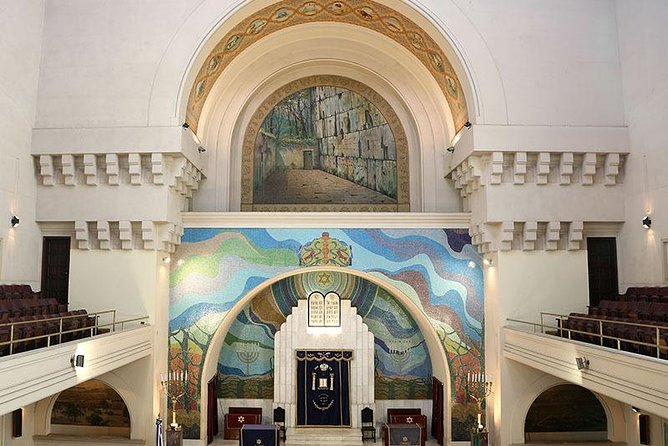
The Grande Templo Israelita do Rio de Janeiro is one of the tour’s main architectural stops. Completed in 1932, it was among the first synagogues in Rio and features a grand archway topped with five smaller arches.
Inside, you can admire mosaics depicting Jewish life. The visit is planned for about 20 minutes, which makes this more of an architectural and historical introduction than an extended tour of the building.
The temple is also connected to a voluntary Tzedakah contribution of $5 per person. This is not presented as a standard admission ticket. You should understand it as a charitable donation requested in connection with the visit, and it is not described as compulsory.
Dress appropriately. This is especially important when visiting religious buildings. The tour information does not set out a detailed dress code, so modest clothing is the sensible choice.
The Grand Temple may be the stop that most clearly rewards a guide who can explain what you are seeing. Without context, arches and mosaics are attractive decoration. With context, they become clues to the community’s religious identity, resources, and confidence in 1930s Rio.
What you get at the Jewish Museum
The Museu Judaico do Rio de Janeiro was founded in 1977 after receiving a donated menorah. It works as both a museum and a cultural center, with permanent displays about the Jewish community in Rio and the traditions of Judaism.
Plan for about 30 minutes here. That is the longest scheduled stop, though it is still a quick visit for anyone who reads every panel or wants to study the objects closely.
The museum’s purpose is broader than displaying old items. Its work joins memory with continuing Jewish culture. It also supports exhibitions, academic research about immigration, and yearly competitions for students. That makes it useful for understanding Jewish life as an ongoing part of Rio, not just something located in the past.
Admission costs $2 per person and is not included in the tour price. The small fee is easy to budget for, but carry some Brazilian currency or a suitable payment method if needed. Ask your guide how much time is available before entering, since the overall schedule is fairly tight.
I would not expect a large national museum. The strength here is focus. You get a compact setting where religious tradition, migration, local community life, and memory meet. If museums are your main reason for booking, you may want to spend extra time in this section and accept that some other stops will remain brief.
Optional community visits and the practical side of Jewish life
The route can include more than historic buildings. One account of the tour included a kosher shop, a Jewish community center, a synagogue, and a full gym and workout center. Another stop involved a pharmacy inside a community center that provides free medicine to people in need.
These details help show how Jewish institutions function today. They are not simply monuments. They can offer worship, social activity, health support, food, and spaces for daily community life.
At the same time, this is where expectations matter. If you want only grand architecture and formal history, a community center may feel less exciting. If you want to understand present-day Jewish Rio, it can be one of the more useful parts of the experience.
Donations may be requested at some Jewish sites. Tzedakah is a Jewish tradition of charitable giving, but the information provided says donations are voluntary. You can decide what feels right for you, and it is sensible to ask which payments are actual entrance fees and which are optional contributions.
The final synagogue visit can be adjusted. You may request Beth Yacov and Beit Lubavitch instead of Synagogue Shel Gmelut Hassidim. Since the exact mix can depend on access and timing, discuss your priorities with the operator before the morning begins.
The guides make the difference
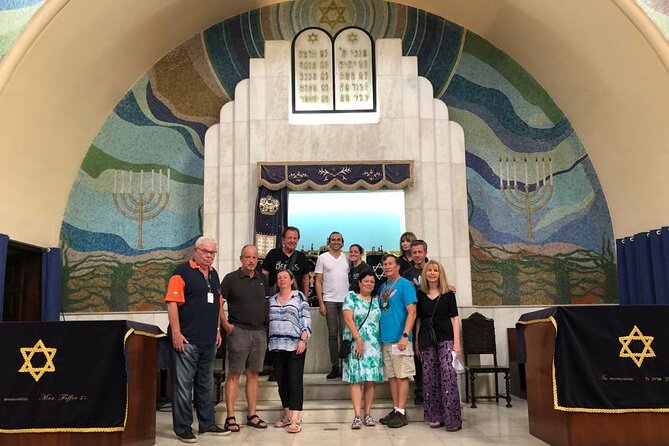
The strongest part of this tour is the human interpretation. Ephraim is repeatedly associated with the experience and is described as warm, engaging, proud of his community, and able to share first-hand knowledge of Jewish life in Rio. He is also described as an octogenarian, yet energetic enough to guide a brisk morning.
Leonardo is another guide named in the tour feedback. He is praised for fluent English, charm, clear explanations, and a knack for telling the story of Jewish Rio in a way that connects places with people.
A multilingual guide may operate the tour, so your exact guide is not guaranteed. If English fluency or a particular guide matters to you, ask the operator when booking rather than assuming.
The experience is best when you treat it as a conversation. Ask about immigration, synagogue life, Jewish businesses, community size, and how Rio’s Jewish institutions work today. The guides are reported to answer questions well, and the tour has enough personal contact to make those questions worthwhile.
There is one caution. One poor account describes a guide taking personal phone calls, delaying the group to admit a visitor to a synagogue, and creating a wait. That does not match the many positive accounts, but it is a reminder that tour quality can depend heavily on the individual guide and the day’s access arrangements.
Price, group size, and what the package is worth
The price is $99.50 per person. That is not a low-cost sightseeing ride, especially since the Jewish Museum and Grand Temple contributions are extra, and the Holocaust Memorial may also have an entry charge.
The value comes from the private transport, hotel pickup and return, guide, and access to places that are difficult to arrange alone. You are not paying only for admission. You are paying for the route, local coordination, translation, historical framing, and the chance to enter or visit several Jewish institutions in one morning.
Groups can reach 19 people, though the vehicle may be a car or minivan. That is small enough for questions but not necessarily intimate. If you are hoping for a fully private experience, confirm the group arrangement before booking.
Pickup is listed at the Hilton Rio de Janeiro Copacabana at 9:00 a.m., with the activity ending back at the meeting point. The tour information also says hotel pickup and drop-off are included, so clarify your exact Rio hotel when booking. Air-conditioned transport is welcome in Rio, especially when moving between distant neighborhoods.
Food and drinks are not included. A kosher lunch can be arranged with advance notice, which is useful if dietary planning matters to you. Do not wait until the morning of the tour to request it.
Free cancellation is available up to 24 hours before the start time. Changes or cancellations inside that window are not accepted for a refund.
Who should book this Rio heritage tour
You should book if you are interested in Jewish history, synagogue architecture, Holocaust remembrance, immigration, or the way a smaller religious community functions in a major city.
It also suits repeat visitors who have already seen Rio’s famous viewpoints and want something more specific. The tour still includes a fine Sugar Loaf view, but its purpose is cultural rather than scenic.
Families can find plenty to discuss, especially at the Anne Frank school, Holocaust Memorial, and museum. Couples and solo visitors may appreciate the direct access to a specialized subject without having to organize several sites independently.
I would hesitate if you want a leisurely museum morning. The schedule moves quickly, and most stops last 20 minutes. I would also hesitate if you expect a huge Jewish quarter filled with attractions. Rio’s Jewish community is not presented as enormous, so the tour works through selected sites, stories, and institutions rather than a long walking district.
Should you book it?
Book this tour if Jewish heritage is a meaningful part of your trip and you value a guide who can connect buildings with lived experience. Ephraim and Leonardo are the names to request, if available, and Thursday through Sunday is the best window if the Holocaust Memorial matters to you.
At $99.50, it is worth the cost for convenient transport and expert local access, but budget another few dollars for the museum and Grand Temple contribution. Go with realistic expectations: this is a focused, fast-moving introduction to Jewish Rio, not a full-day museum program.
FAQ
How long does the Rio Jewish Heritage Tour last?
The tour is listed as approximately three hours, although some descriptions call it a four-hour tour. Plan for a half-day morning activity.
What time does the tour start?
The listed start time is 9:00 a.m.
Where does the tour start?
The meeting point is the Hilton Rio de Janeiro Copacabana at Av. Atlântica, 1020, Copacabana.
Does the tour include hotel pickup and drop-off?
Yes. Hotel pickup and drop-off are included, and the activity ends back at the meeting point.
What transportation is used?
Transport is provided in an air-conditioned minivan or car.
How large can the group be?
The tour can have a maximum of 19 participants.
Is the Jewish Museum entrance included?
No. The Jewish Museum entrance fee is listed as $2 per person.
Is the Grand Synagogue entrance included?
The Grand Synagogue requests a $5 per person Tzedakah contribution. This is separate from the tour price.
Can I visit the Holocaust Memorial on any day?
No. The memorial is open only from Thursday through Sunday, so plan your tour for one of those days if you want to visit it.
Is kosher food available?
Yes. Kosher lunch is available by previous request. Food and drinks are not included in the standard tour price.
Just added in Rio de Janeiro
- Rio de Janeiro: Zip Lining and Canopy Tree Tour★ 3.3 · 6 reviews
- Vidigal Favela Tour★ 4.4 · 26 reviews
- Rio de Janeiro: Attend a Vasco da Gama game with local guide★ 4.8 · 9 reviews
- Unforgettable Boat Party★ 5.0 · 3 reviews
- Hang gliding flight in Rio de Janeiro★ 5.0 · 6 reviews
- Rio Highlights: Christ, Sugarloaf, and More in a Private Tour★ 5.0 · 36 reviews
- Tijuca Forest Hike – Waterfalls & Caves, Nature & Wild Life!★ 5.0 · 51 reviews
- Rocinha Walking Tour: Get a Feel for the Brazil’s Largest Favela (Shared Group)★ 5.0 · 37 reviews
Historical Tours, compared.


Scenic Train ride to historical cities of Morretes and Antonina
Read our review →
From Foz do Iguazu: Triple Frontier Landmark Ticket
Read our review →
Explore Little Africa : Unveiling Afro Heritage in Rio de Janeiro
Read our review →
Downtown-Center History Walking Tour – in English
Read our review →Browse the lists this tour appears in