
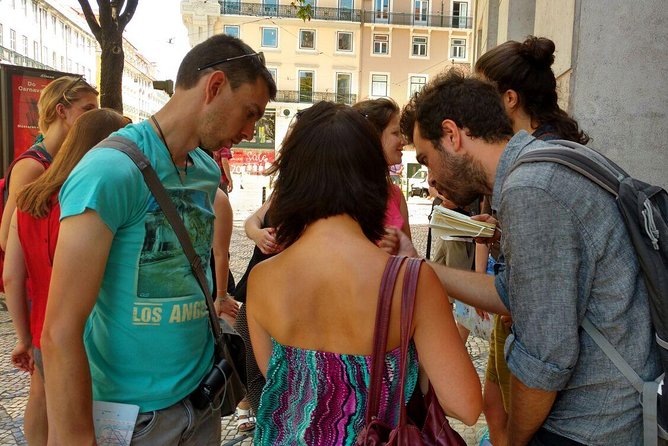
Reviewed · WALKING TOURS
Sao Paulo: Downtown-Center History Walking Tour – in English
São Paulo’s center is a crash course in Brazil: Jesuit beginnings, coffee wealth, modernist ambition, Japanese immigration, street markets, and social change all appear along one roughly 3-kilometer walk. I like that the route connects famous landmarks with less polished places such as underground shopping corridors and the Gallery of Rock. I also like the small group size, which gives guide Giuliano room to answer questions and adjust the pace.
The main drawback is simple: this tour begins at exactly 10:00 a.m. and cannot wait for late arrivals. São Paulo traffic can be slow, so arrive early. The center also calls for normal big-city awareness, even though the walk itself stays on a well-used route.
Key points at a glance
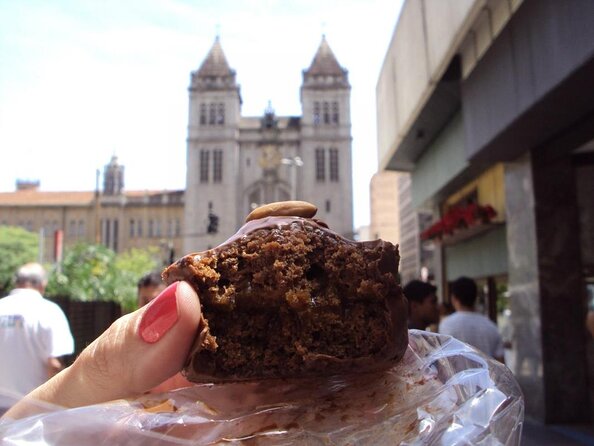
- Edifício Copan and modern São Paulo: See Oscar Niemeyer’s great curved apartment building and learn how the city grew upward.
- A route through eight major stops: The walk links Centro Novo, the old center, Sé, and Liberdade in one morning.
- Stories beyond the standard guidebook: Giuliano adds political, social, and cultural context to the buildings around you.
- Liberdade’s food and market culture: Finish among lanterns, Japanese-Brazilian businesses, produce, and authentic foods.
- Small group, practical pace: No more than 10 people join, with time for photos, questions, coffee suggestions, and local advice.
- A firm two-hour schedule: The tour is useful on a first morning in São Paulo, but each stop receives about 15 minutes, so interiors and museums are not the main focus.
Why this São Paulo walk works so well
I like this experience because it gives you a clear mental map of central São Paulo without trying to cover the entire city. The route begins in Centro Novo, passes through the old colonial core, and ends in Liberdade, a district shaped by immigration and food culture.
You are not simply moving from one photo stop to the next. The guide uses architecture to explain how São Paulo changed. Coffee money helped finance grand buildings and cultural institutions. Modernist architects responded to a city growing at remarkable speed. Churches and plazas reveal the power structures behind the city’s founding.
The English-language guiding is a major part of the value. Giuliano is described as friendly, attentive, and able to handle questions on São Paulo’s history, politics, architecture, and social changes. Past participants also found his restaurant, coffee, and evening suggestions useful, so keep a note on your phone for recommendations you may want to follow later.
The group limit of 10 matters. Central São Paulo can be noisy, crowded, and visually busy. A small group makes it easier to hear the guide, ask about details, and stop for photos without forming a long line. The pace is intended to be comfortable rather than a race, with shade sought where possible.
More history walks in São Paulo
- São Paulo: Downtown Historical Bike Tour
★ 4.9 · 191 reviews - Best São Paulo City Tour History 5Hours Private Experience.
★ 4.0 · 3 reviews - Rio de Janeiro: Historic Rio and Santa Teresa Half-Day Tour
★ 4.4 · 228 reviews
Starting under Edifício Itália
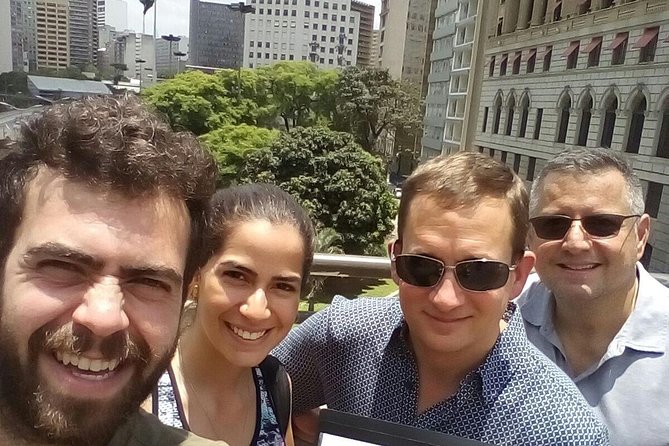
Meet at 10:00 a.m. outside Edifício Itália on Avenida Ipiranga. This is a smart starting point because the building introduces the scale and ambition of modern São Paulo immediately.
Edifício Itália was once the tallest building in the city. Even without entering, you get a useful sense of the vertical city around you: office towers, apartment blocks, older façades, traffic, and layers of construction from different periods.
I recommend arriving early here, not just on time. The tour has a strict departure policy, and the guide keeps the phone off once the walk begins so attention stays with the group. If you arrive only a few minutes late, you may miss the entire experience.
Oscar Niemeyer’s curved Copan Building
The short walk to Edifício Copan shifts the subject from height to shape. Designed by Oscar Niemeyer, Copan is known for its broad, sweeping curve and huge scale. It captures the confidence of mid-century Brazilian modernism, when architects and city planners imagined a new urban future.
This stop works best if you look beyond the famous outline. The building reflects São Paulo’s rapid vertical growth and the tension between grand design and the practical disorder of a huge city. The guide connects the structure to the period when São Paulo was reinventing itself through industry, migration, and dense apartment living.
You will have time for photographs, but this is not a full architectural tour or an apartment visit. The value comes from the explanation of what Copan represents within the city.
Records, manga, and subculture at the Gallery of Rock
The Gallery of Rock adds a welcome change of tone. Instead of grand institutions, you explore galleries and underground shopping spaces filled with vinyl records, antiques, manga, and pop culture items.
This area shows a different side of central São Paulo. It is linked to collectors, music fans, and subcultures, and it gives the walk a contemporary edge. The stop also helps explain why the center is more than a collection of historic façades. People still use these spaces for trade, identity, and creative expression.
If you enjoy browsing, allow yourself a little time after the tour to return to places that catch your eye. The itinerary gives the stop about 15 minutes, enough for an introduction but not for a long shopping session.
More walking tours in São Paulo
- Sao Paulo: Downtown-Center Walking Tour | 2 Hours – English
★ 4.9 · 84 reviews - Ecological walk in sao paulo
★ 5.0 · 61 reviews - Rio de Janeiro: Rocinha Favela Walking Tour with Local Guide
★ 4.8 · 3,052 reviews - Rio De Janeiro: Half-Day Rocinha Favela Walking Tour
★ 4.7 · 2,272 reviews
Theatro Municipal and Brazil’s modern artistic voice
The Municipal Theatre is one of the grandest buildings on the route. Its European-inspired design reflects the wealth and confidence of São Paulo’s coffee era, when local elites wanted a cultural institution to match the city’s economic power.
The more important story here is the 1922 Week of Modern Art. Artists challenged old European models and argued for a more distinctly Brazilian form of expression. The theatre therefore represents both refinement and rebellion, a useful pairing for understanding Brazil’s cultural identity.
This is one of the stops where the guide’s storytelling adds real value. A quick photograph tells you that the building is ornate. The historical explanation tells you why it mattered and how artists used culture to question older ideas about Brazil.
Coffee wealth at Centro Cultural Banco do Brasil
At Centro Cultural Banco do Brasil, the focus turns to art déco design and the money behind São Paulo’s early twentieth-century growth. Grand façades from the coffee boom show how wealth funded infrastructure, cultural spaces, and urban improvements.
The guide also addresses the sharp social contrasts tied to that wealth. São Paulo’s polished public buildings were not created in isolation. They grew from an economy shaped by coffee production, labor, migration, and unequal access to opportunity.
This is a useful stop for anyone who wants more than dates and architectural labels. You begin to see the center as a record of who had money, who made the city function, and who benefited from its growth.
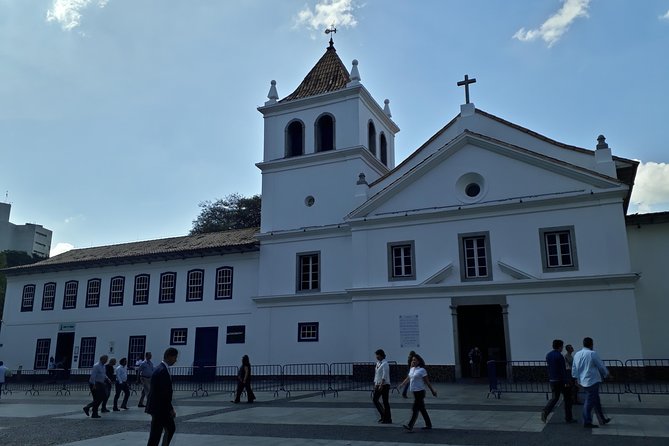
Pátio do Colégio and the city’s difficult beginning
At Pátio do Colégio, you reach the place traditionally associated with São Paulo’s founding in 1554. Jesuit missionaries established a settlement here, but the story is not presented as a simple tale of heroic founders.
The guide brings in the Tupi-Guarani peoples who shaped the area before and during colonization. That makes this plaza an important place to consider the relationship between religion, political power, Indigenous communities, and European expansion.
I value this part of the walk because it gives the city a beginning without pretending the beginning was uncomplicated. The buildings and plaza are visually calm, but the history involves competing interests and unequal power.
Sé Cathedral and the symbolic center
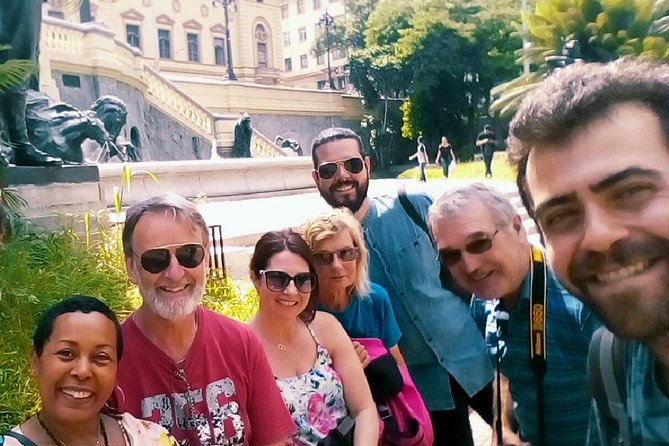
Sé Cathedral is the route’s most imposing religious landmark. Its neo-Gothic form dominates the square, and its location marks São Paulo’s symbolic center, often described as the city’s ground zero.
The stop goes beyond architecture. Sé has also been a place for public gatherings, protest, religious practice, and civic identity. That makes the cathedral useful for understanding how a central square can function as both a spiritual site and a political one.
A practical point: the cathedral is one of the places where you may have an opportunity to use facilities during the walk, based on the experience details. Still, this is a walking tour with several outdoor stops, so comfortable shoes and water are sensible choices.
Finishing in Liberdade’s Japanese-Brazilian streets
The final stop is Praça da Liberdade, where the tour ends near the Base da PM at number 125. This is a satisfying finish because the neighborhood changes the story again.
Liberdade is widely known as the largest Japanese neighborhood outside Japan. Its lanterns, markets, restaurants, produce, and specialty foods reflect Japanese immigration, but the district also shows São Paulo’s broader mix of communities and traditions.
The tour’s emphasis on street-market produce and authentic foods is especially useful here. You learn what you are looking at instead of simply passing through a row of stalls. The end of the walk is a good time to ask Giuliano for food or coffee ideas, then stay in the area for your own exploration.
The route does not promise a tasting menu or a dedicated food tour. Think of Liberdade as the place where the guide explains the neighborhood and points out what deserves a closer look.
What you get for $31.24
At $31.24 per person, the tour sits in a reasonable range for a two-hour guided walk, especially with a maximum of 10 people. You are paying for interpretation, not admission tickets. Every listed stop has free entry, so the price mainly covers the guide’s time, research, route planning, and local perspective.
The value is strongest if you are new to São Paulo or have only a morning available. A good guide can save you from treating the historic center as a disconnected set of buildings. You leave with a sense of how Centro Novo, the colonial core, Sé, and Liberdade relate to one another.
The value is lower if you want long visits inside museums, detailed architectural analysis, or extended time at the market. Fifteen minutes at each of eight stops creates a broad overview rather than a slow study of any single site.
Several people praised the clear explanations, easy pace, and practical recommendations. One participant used suggestions for a restaurant and a theatre after the walk. That kind of local follow-up can make the fee worthwhile, particularly on your first day.
Timing, walking, and group details
The experience lasts about two hours and covers roughly 3 kilometers. You should expect steady walking through central streets, plazas, and commercial areas, with stops for explanation and photographs.
Most people can participate, and the route is near public transportation. Service animals are allowed. The information provided does not promise a fully step-free route, so if you have specific mobility needs, confirm the details before booking.
The activity requires good weather. If poor weather causes cancellation, you are offered another date or a full refund. For a normal day, wear shoes suited to city pavement and plan for outdoor conditions.
The most important practical rule is punctuality. The meeting point is Av. Ipiranga, 344, and the walk starts at 10:00 a.m. The guide cannot delay the group for late arrivals. São Paulo traffic is a real planning issue, so build in extra time and aim to arrive before the stated start.
Who should book this walk
I would choose this tour for a first visit, a short stay, or the first morning of a longer São Paulo trip. It gives you orientation, basic historical context, and several ideas for the rest of your visit.
It also suits people who enjoy architecture but want more than buildings. The route links Niemeyer’s modernism, coffee-era art déco, neo-Gothic religion, Japanese-Brazilian food culture, and contemporary shopping spaces.
Solo visitors and couples should appreciate the small group format. It is also a good fit if you like asking questions, since the guide has been praised for answering them carefully and keeping the mood light.
You may want something else if your priority is shopping, food tasting, museum interiors, or a private tour. The route is broad, and its purpose is to explain the city rather than spend an hour at one attraction.
Should you book the São Paulo Downtown-Center History Walking Tour?
Book it if you want a compact, English-language introduction to São Paulo’s center with a guide who can connect architecture, immigration, politics, art, and everyday city life. The combination of eight stops, a 3-kilometer route, a 10-person limit, and a $31.24 price makes it a sensible orientation walk.
Just arrive early, wear comfortable shoes, and keep your expectations clear. This is a fast-moving overview with strong storytelling, not a series of long interior visits. If that sounds right, it is one of the better ways to make sense of central São Paulo before exploring the city on your own.
FAQ
How long does the walking tour last?
The tour lasts approximately two hours.
How far does the group walk?
The route covers about 3 kilometers through central São Paulo.
What time does the tour begin?
The tour starts at 10:00 a.m.
Where does the tour begin?
The meeting point is Edifício Itália, at Av. Ipiranga, 344, Centro Histórico de São Paulo.
Where does the tour end?
The walk ends at Praça da Liberdade, near Base da PM at Praça da Liberdade, 125.
How large is the group?
The tour has a maximum of 10 participants.
Is the tour conducted in English?
Yes. This experience is an English-language walking tour.
Can I cancel for a full refund?
You can cancel at least 24 hours before the start time for a full refund. Cancellations or changes made less than 24 hours before the start are not refunded.
Just added in São Paulo
- Corinthians Football Game Experience★ 4.8 · 33 reviews
- Companionship of a bilingual guide in São Paulo★ 4.8 · 10 reviews
- Best São Paulo City Tour History 5Hours Private Experience.★ 4.0 · 3 reviews
- From São Paulo: Aparecida Cathedral Tour★ 4.8 · 10 reviews
- The Brazilian Switzerland – Day Trip on Campos do Jordão from São Paulo★ 4.5 · 53 reviews
- Campos do Jordão – Brazilian Switzerland departing from São Paulo★ 4.5 · 53 reviews
- Wine Tour in São Roque by Car, Tour with Local Guides★ 5.0 · 60 reviews
- Street Art and Park Bike Tour★ 5.0 · 56 reviews
Walking Tours, compared.

Sunrise and Sunrise Walk Two Brothers with Local Guide
Read our review →
Downtown-Center Walking Tour | 2 Hours – English
Read our review →
Learn the History of Rio with an Unforgettable City Center Walking Tour
Read our review →
Rio’s city walking tour: a glimpse of history and olympic legacy
Read our review →Browse the lists this tour appears in