Reviewed · EVERY TOUR
Civic, Legal and Architectural Citytour
Brasilia is a city best understood from a car window. Its broad avenues, distant buildings, and monumental civic spaces make walking between sights slow and sometimes impractical, while a private guide can connect Oscar Niemeyer’s curves, Lucio Costa’s plan, and the story of Brazil’s new capital in one morning. The four-hour route covers an astonishing amount, from the Cathedral to the presidential residence and Lake Paranoá.
I like the efficient private format, which lets you ask questions and adjust the pace, and I like the mix of famous architecture with less obvious stops such as the blue-lit Dom Bosco Sanctuary and Burle Marx’s Praça dos Cristais. The main caution is that this is a quick overview, not a slow architecture seminar, and access to some buildings can depend on the day, security, opening hours, or working elevators.
Key points before you book
- A car is the sensible way to see Brasilia: The city’s monumental axis and widely spaced sights are not designed for a relaxed walking tour.
- Niemeyer is the connecting thread: The Cathedral, Congress, Three Powers Square, Army Headquarters, and Igrejinha Nossa Senhora de Fátima reveal different sides of his work.
- The guide matters: Alberto, Michael, Anselmo, Flavio, Jose, and Ambrosio are among the guides praised for clear English, local insight, and friendly service.
- The route mixes politics and religion: You’ll see Brazil’s main federal institutions alongside the Cathedral, Dom Bosco Sanctuary, and an ecumenical temple.
- Expect a brisk pace: Stops range from five minutes at the stadium to 40 minutes at the JK Memorial.
- Plan for changing access: The Alvorada Palace offers guided tours on Wednesdays, and the TV Tower requires identification and a working elevator.
Why Brasilia makes a good private city tour

Brasilia can feel confusing at first. Its central plan is famous, but the logic is easier to grasp once you see the Monumental Axis, the residential wings, the broad traffic routes, and the major government buildings in sequence. A guide can explain why the city feels so open and why many landmarks that look close on a map are not especially convenient to reach on foot.
This tour is built around that big-picture understanding. You are not simply ticking off buildings. You are moving through the civic core, visiting religious spaces, stopping for views, and learning how Juscelino Kubitschek’s capital took shape.
The private arrangement is particularly useful for a small group of up to four people. At $170 per group, the cost is easier to justify when divided among two, three, or four people. For one person, it is a more serious expense, but it also buys transport, a guide, and a focused half-day introduction to a city where arranging all these stops independently would take effort.
Several guides have earned especially strong praise. Alberto is described as a lifelong resident with excellent English, a clean and comfortable vehicle, and a habit of contacting guests the night before to confirm plans. Michael has been appreciated for his enthusiasm and ability to explain what it is like to live in Brasilia. Anselmo, Flavio, Jose, Ambrosio, and others have also been singled out for clear explanations and good humor.
That said, guide quality and service details can vary. One booking had a late change from morning to afternoon, which disrupted the planned day. Another visitor felt the guide was too passive, and there was disappointment about water and air conditioning during very hot weather. I would confirm the meeting time, language, vehicle, and expected stops in advance.
More Tours in Brazil
- Rio de Janeiro: 6-Stop Highlights of Rio with Lunch
★ 4.4 · 5,157 reviews - Christ the Redeemer Entry Ticket by Corcovado Train
★ 4.4 · 4,476 reviews - Rio de Janeiro: Rocinha Favela Walking Tour with Local Guide
★ 4.8 · 3,052 reviews
Cathedral, Congress, and the first look at Niemeyer
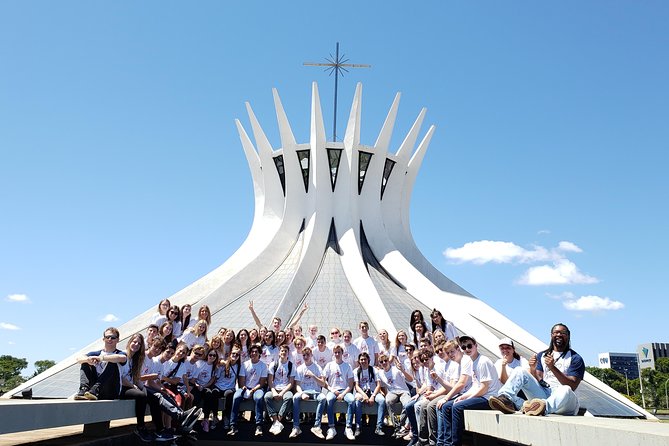
The Metropolitan Cathedral is one of the strongest opening stops. Niemeyer designed it as a crown-like structure, with curved concrete ribs rising around a large interior space. A reflecting pool frames the approach, while artwork by modernist artists adds color and movement.
You receive about 15 minutes here, enough for photographs and a first explanation of Brasilia’s design language. If architecture interests you, look beyond the unusual exterior. The building shows how Niemeyer used structure, light, and open space to make a church feel unlike a traditional European basilica.
The National Congress follows, with roughly 20 minutes. Its paired towers and contrasting domes are among the most recognizable images in Brazil. The complex houses the legislative branch, and guided tours may be available in English, Portuguese, and another listed language depending on the schedule.
The exact experience inside can vary. Some visits may focus on the exterior, while an organized visit may include more of the building. If you want interior access, ask your guide early in the day rather than assuming it is guaranteed.
These first two stops set the tone. You see how religious and political buildings were given bold shapes, but you also begin to understand the practical challenge of Brasilia: enormous spaces, formal buildings, and long distances between them.
Blue light at the Dom Bosco Sanctuary
The Sanctuary of Saint John Bosco offers a welcome change from the white concrete of the civic center. Its interior is known for tall blue stained-glass windows that fill the space with cool, intense light.
The stop lasts about 20 minutes. That is enough time to sit quietly, take in the color, and hear why the shrine is considered one of Brasilia’s most striking works. The atmosphere is less about political power and more about light, mood, and devotion.
This is one of the places that gives the tour needed variety. If you only visit government buildings, Brasilia can seem like a study in concrete and official ceremony. The sanctuary shows the city’s religious side and gives you a different way to think about modern Brazilian design.
The JK Memorial and the story behind the capital
The 40-minute stop at the JK Memorial gives the tour its strongest historical anchor. Juscelino Kubitschek was the president who drove the creation of Brasilia, and the memorial is dedicated to his life and role in founding the capital.
Inside, you can see photographs and videos connected with the construction of the city, along with artworks and a coffee area. The visit helps turn the city from an abstract architectural project into a human and political undertaking. You learn about the ambition, planning, and effort involved in building a new capital inland.
I would give this stop your full attention. The buildings are impressive, but the memorial explains why they exist and why Brasilia was built in the first place. If you are especially interested in design, you may wish to ask for extra time here, although the overall route leaves limited room for a long museum visit.
Same city, a different sort of day:
- Rio de Janeiro: Sugarloaf Cable Car Official Ticket
★ 4.6 · 2,873 reviews - Rio: Christ the Redeemer, Sugarloaf, Selaron & BBQ Lunch
★ 4.5 · 2,428 reviews - Rio De Janeiro: Half-Day Rocinha Favela Walking Tour
★ 4.7 · 2,272 reviews - Rio de Janeiro: Angra dos Reis and Ilha Grande Full-Day Tour
★ 4.6 · 1,673 reviews
An ecumenical pyramid and the JK Bridge
The Temple of Good Will is one of the route’s more unusual stops. This ecumenical temple welcomes all religions and is shaped like a pyramid. A large crystal at the top is part of the building’s spiritual symbolism, and visitors walk a spiral route inside the nave.
You have about 30 minutes here. The experience is quite different from the official grandeur of Congress or the formal geometry of Three Powers Square. Some people will find the symbolism fascinating; others may prefer to spend more time with Niemeyer’s work. It is worth keeping if you want a broader picture of Brasilia’s religious and cultural life.
The viewpoint at JK Bridge takes about 10 minutes. The bridge crosses Lake Paranoá and is one of the city’s most photographed modern structures. From the lookout, you can see the lake, the bridge’s repeated arches, and the wider setting of Brasilia.
This is a short photo stop rather than a long lakeside visit. Restaurants are located in the area, but a four-hour tour usually does not leave time for a meal. The value here is visual: after seeing the city’s official core, you get a sense of its water, open space, and leisure side.
Three Powers Square and the presidential residence
Praça dos Três Poderes is the political heart of Brasilia. The square brings together the executive, legislative, and judicial branches, with major buildings arranged around a vast open space.
Your guide can help you read the symbolism of the area, which may otherwise feel oversized and severe. This is a place where scale matters. The square was designed to express the reach of the federal government, and its open layout makes the surrounding structures feel even more monumental.
The Palácio da Alvorada is the official presidential residence and was the first building inaugurated in Brasilia. The curved design reflects Niemeyer’s softer approach to official architecture, but access is limited. Guided tours are received on Wednesdays, so do not assume you will enter on another day.
Even when the road or access area is closed, the exterior remains an important part of the city’s story. Conditions can change because of official activity and security, so keep your expectations flexible.
TV Tower, Army Headquarters, and a small church
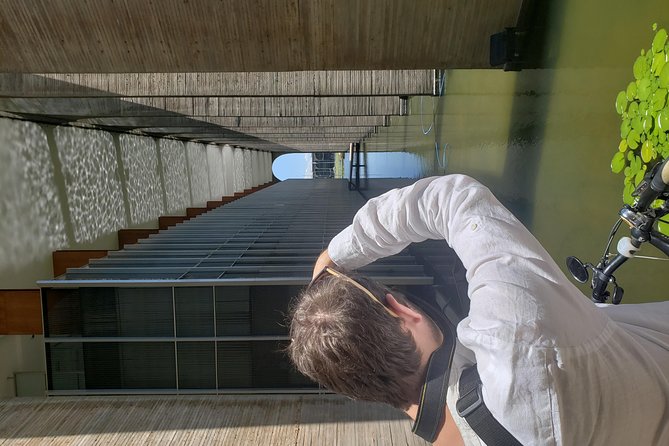
The TV Tower is connected with Lucio Costa’s plan for the city and was built to receive analogue television signals. The lookout is 75 meters high and reached by elevator. Identification is mandatory, and climbing the stairs is not allowed.
The viewpoint can provide one of the best ways to understand Brasilia’s layout from above. You can see the broad avenues and planned arrangement more clearly than from street level. But the elevator is essential, and mechanical problems have occasionally prevented access. If the tower is closed, your guide can still explain its role, but the stop will not offer the intended view.
At Army Headquarters, you will see a complex designed by Niemeyer that includes an acoustic shell, a theater, and Praça dos Cristais. The square was designed by Roberto Burle Marx, giving you a chance to compare two important figures in Brazilian modernism.
The stop lasts about 20 minutes. It is most useful if your guide explains how the landscape design works with the buildings rather than treating the area as another quick photo stop.
Igrejinha Nossa Senhora de Fátima is smaller and more intimate. Niemeyer designed this little church at the request of Sarah Kubitschek, Juscelino Kubitschek’s wife. It was built beside a model residential block intended to guide the development of the rest of Brasilia.
The 15-minute visit helps you see how the city’s grand modernism reached ordinary neighborhood life. Not every important building in Brasilia is enormous. This small church has a more personal scale and makes a pleasant contrast with the government axis.
The stadium and the rhythm of the route
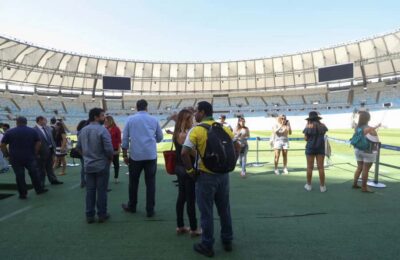
The final photo stop is the Mané Garrincha National Stadium, where you spend about five minutes. This is a quick exterior look, not a stadium tour.
The full route includes 12 stops, and the listed visit times add up to just under four hours before driving between locations. That explains the brisk rhythm. You will usually get time to photograph each place and hear a useful explanation, but not time to linger at every interior.
This is why the private format matters. You can tell the guide if the JK Memorial or Cathedral matters more to you than the stadium. One person interested mainly in Niemeyer may want extra time inside architectural works, while another may prefer the political history and city planning.
A tour by car also protects your energy in Brasilia’s hot, sunny conditions. One guide wisely suggested starting earlier to avoid the worst afternoon heat, and 9:00 a.m. is a sensible start. Ask for air conditioning and water before setting out rather than assuming these details will be handled automatically.
What the $170 price really buys
The $170 price is for the whole group, up to four people, not per person. For four people, that works out to $42.50 each. For two people, it is $85 each, and solo visitors pay the full group rate unless the provider offers another arrangement.
The strongest value comes from the coverage. In four hours, you can reach the Cathedral, Congress, the JK Memorial, the Three Powers Square, the Alvorada Palace area, the TV Tower, the sanctuary, the bridge, the church, the Army Headquarters, the temple, and the stadium. Reproducing that route with separate taxis or rides would take planning and would leave you without a guide’s explanations.
The price is less convincing if you only want a slow visit to two or three buildings. It also depends heavily on the guide. A good guide can explain the city’s plan, Brazilian politics, modernist architecture, and daily life in a way that makes the drive meaningful. A less engaged guide may make the same route feel like a sequence of hurried photo stops.
The experience is recommended by 90 percent of purchasers and carries a 4.7 rating from 81 reviews, which fits the general pattern: strong praise for the guides, the amount covered, and the way the tour makes Brasilia easier to understand, with a few concerns about communication, timing, and comfort.
Practical details for a smoother morning
You receive confirmation when booking, and the tour begins at 9:00 a.m. It is a private activity, so only your group participates. That gives you more room to ask questions and request small changes than a large coach tour would.
Most people can take part, and service animals are allowed. The route is near public transportation, but the actual sightseeing is much easier by vehicle because of the city’s scale.
Wear practical clothing for brief outdoor stops and bring identification for the TV Tower. You should also carry water, even if the guide provides it. Brasilia can be hot and bright, and several stops involve open plazas with little shade.
Access is not fixed at every site. The TV Tower requires a working elevator, the Alvorada Palace has guided tours on Wednesdays, Congress access may depend on its tour schedule, and official areas can close without much warning. If one place cannot be entered, the guide can still provide an exterior explanation, but you should not book this expecting guaranteed interior access everywhere.
Free cancellation is available up to 24 hours before the start time. Changes or cancellations made inside that period are not refunded, and poor weather can lead to a different date or a full refund.
Should you book the Brasilia city tour?
I would book this tour if you have one day in Brasilia, care about architecture or public history, and want the city to make sense quickly. It is especially useful for first-time visitors, families, small groups, and anyone who does not want to work out the city’s long distances alone.
The route is also a good match for an architecture-minded visitor who wants an introduction to Niemeyer, Lucio Costa, and Burle Marx without spending the entire day in museums. Ask in advance for a guide with strong English and explain which buildings matter most to you.
I would hesitate if your priority is extended time inside each building or a highly specialized architectural study. The tour moves fast, and access can change. But for a well-priced private overview, the combination of transport, context, political sites, religious buildings, and city views is hard to beat. Choose a morning start, confirm the details, and treat the itinerary as a flexible framework rather than a promise that every door will be open.
FAQ
How long does the Civic, Legal and Architectural Citytour last?
The tour lasts approximately four hours and begins at 9:00 a.m.
How many people can join the private tour?
The price covers one private group of up to four people. Only your group participates.
What does the tour cost?
The listed price is $170 per group of up to four people.
Is admission included at the stops?
Admission is free at the listed stops except for the JK Memorial, where admission is included.
Can I visit the Palácio da Alvorada?
The presidential residence receives guided tours on Wednesdays. Access on other days is not guaranteed.
What do I need to visit the TV Tower lookout?
You must present an identification document. The lookout is reached by elevator, and climbing the stairs is not allowed.
Just added in Brazil
- From Puerto Iguazu: Itaipu Dam Tour with Entrance Ticket★ 4.7 · 31 reviews
- From Puerto Iguazu: Secret Falls Adventure★ 5.0 · 5 reviews
- Gramado and Canela private trip with English speaking guide★ 5.0 · 6 reviews
- From Natal: Pipa, Cacimbinhas, And Love Beach Full-Day Tour★ 4.5 · 14 reviews
- From Puerto Iguazú: Brazilian Bird Park Tour with Tickets★ 4.7 · 7 reviews
- from Foz do Iguaçu: Private Tour on Argentinean Falls★ 5.0 · 5 reviews
- From Jericoacoara: Preá Beach and Paradise Lagoon Tour★ 3.8 · 51 reviews
- From Manaus: Negro River Half-Day Trip★ 4.7 · 20 reviews
Tours in Brazil, compared.

Christ the Redeemer Entry Ticket by Corcovado Train
Read our review →
Christ the Redeemer, Sugarloaf, Selaron & BBQ Lunch
Read our review →